Blog · May 22, 2025 · Artificial Intelligence, Policy Synth, Collective Intelligence
From 2,200 Worker Voices to AI Policy: The New Jersey Model
When governments write policy about artificial intelligence, the people most affected by the change are often consulted late, lightly, or not at all. That is a serious problem when the subject is work.
Generative AI will not affect every worker in the same way. It may create new opportunities for some, automate tasks for others, change the value of skills, reshape management practices, and make familiar career paths less predictable. A useful public policy response needs evidence, but it also needs a clear signal from workers themselves.
New Jersey's AI Task Force offers one practical model for how to do that.
Established by Governor Phil Murphy in October 2023, the Task Force was asked to advise the state on artificial intelligence across safety, workforce, equity, literacy, and innovation. Its Workforce Training and Jobs of the Future Working Group faced a question that is becoming urgent everywhere: how should a state prepare workers for a labor market being changed by generative AI?
The answer was not to ask AI to decide. The answer was to combine public input, AI-assisted research, and human review.
Start With Workers
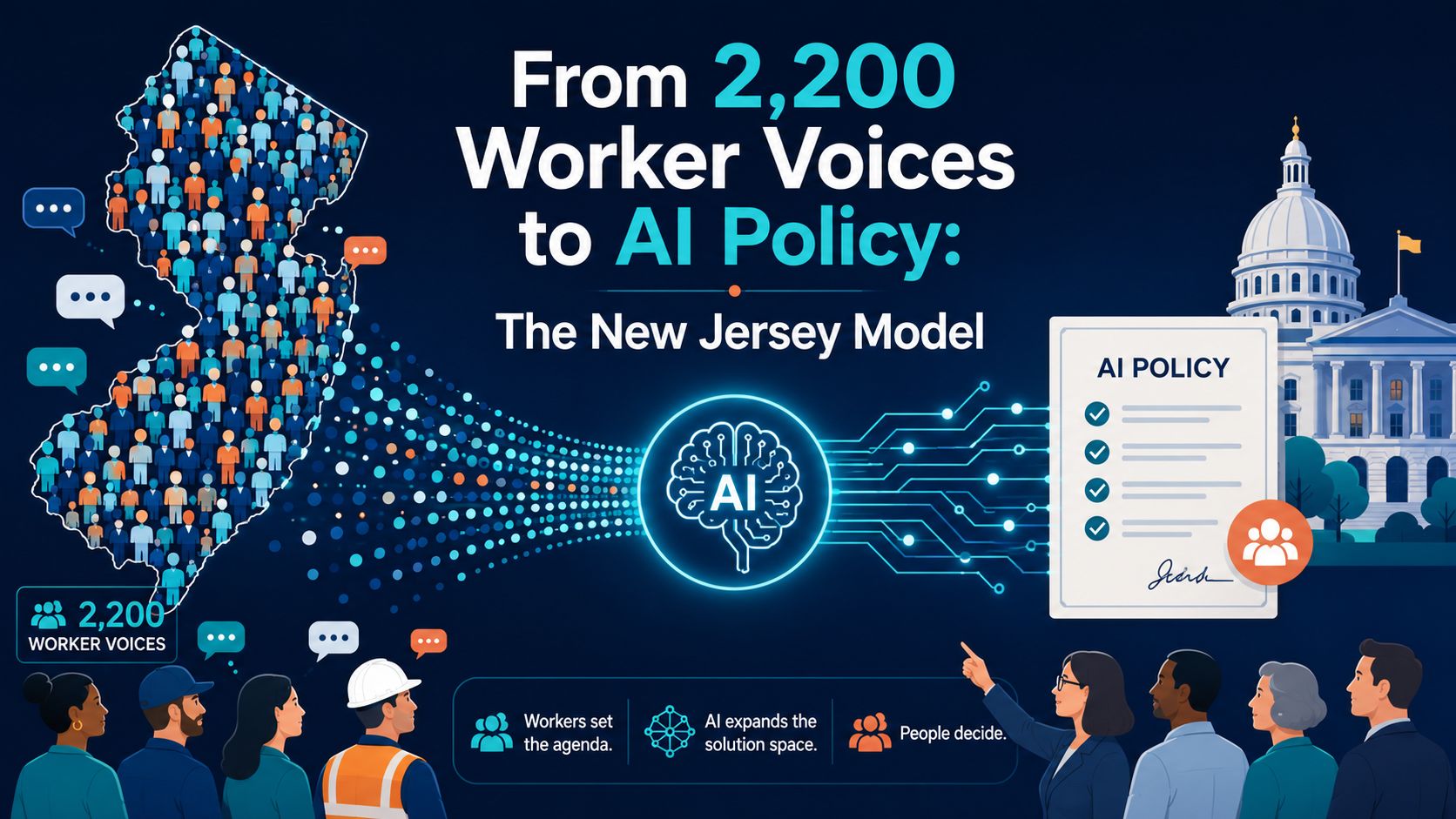
The working group first needed to understand what New Jersey workers were worried about. Using large language models, the team generated 96 concise challenge statements about the possible effects of AI on the state's economy and workforce. Those statements were not treated as answers. They became material for public prioritization.
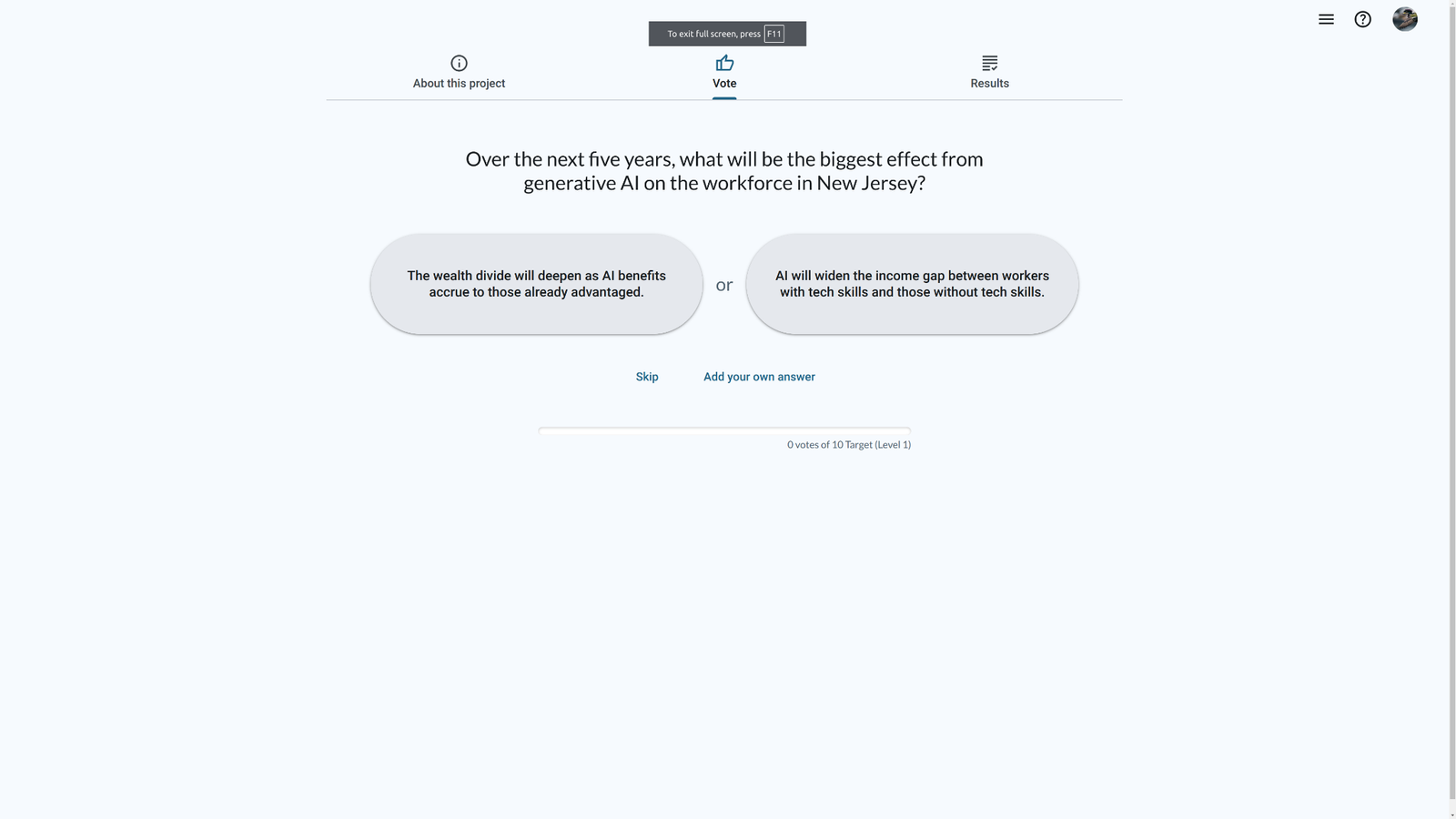
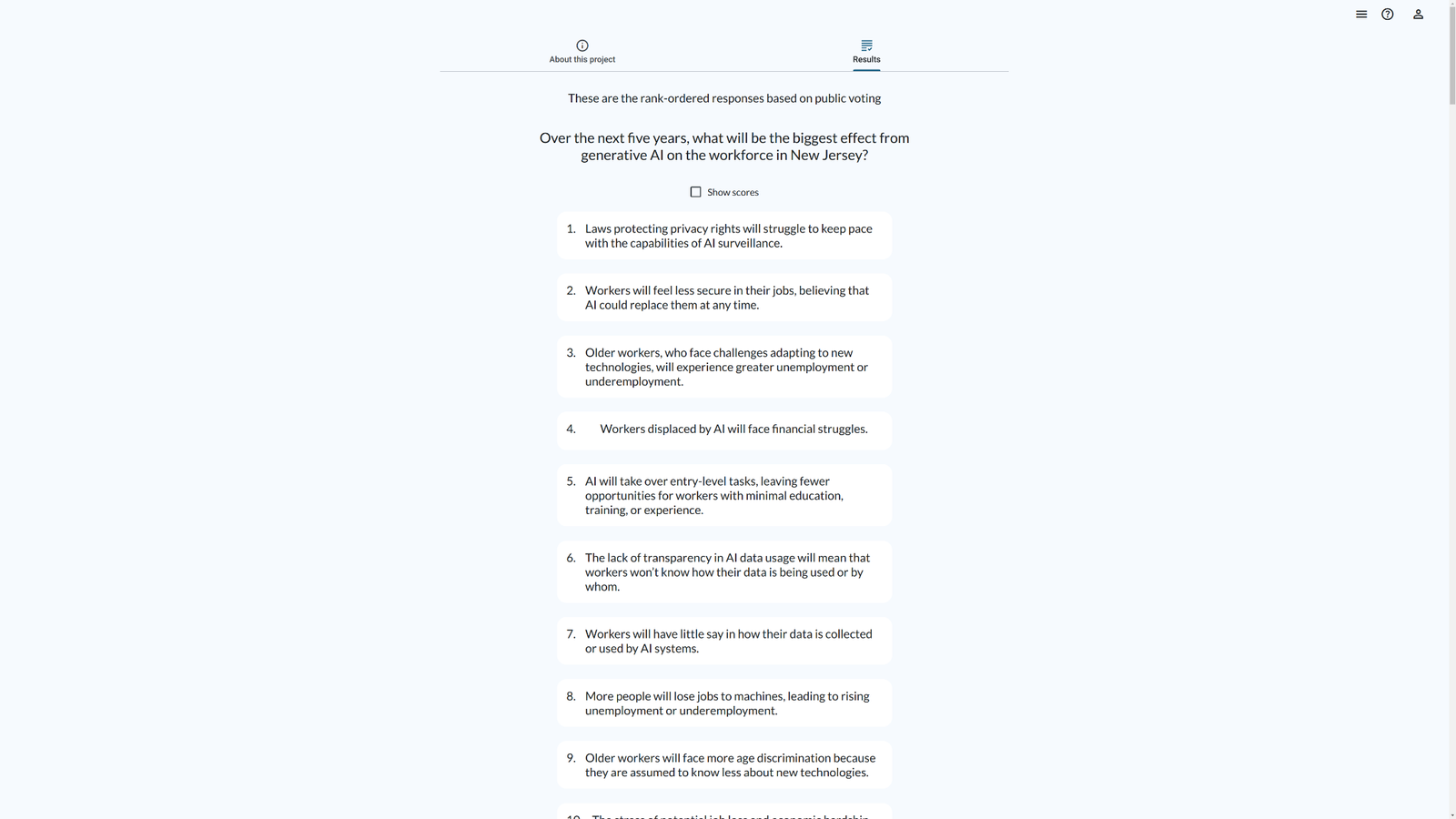
Through the "AI and You" engagement, workers used All Our Ideas to compare concerns and help build a ranked list. Over three weeks in August 2024, more than 2,200 private-sector workers participated. The result was not a traditional survey average or a stack of unstructured comments. It was a rank-ordered public signal about which AI workforce concerns felt most important to the people closest to the issue.
That matters because public engagement often fails at the handoff. Governments collect comments, publish a summary, and then move back into expert-only policy design. In New Jersey, the public ranking became an input into the next stage of policy development.
Use AI for the Research Work
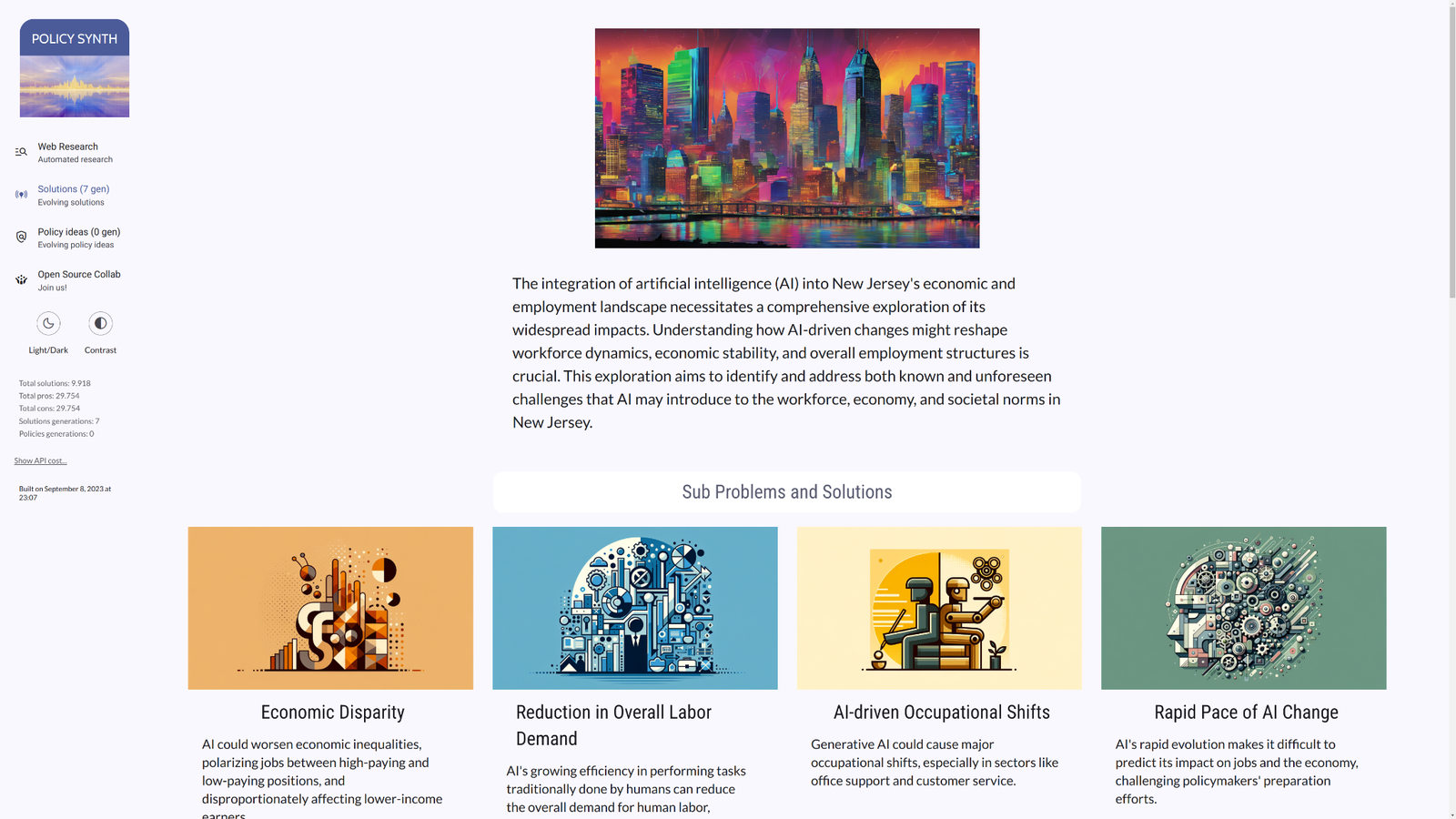
The working group then used Policy Synth, the open-source AI toolkit developed by Citizens Foundation and The GovLab, to turn the priority problems into possible solutions.
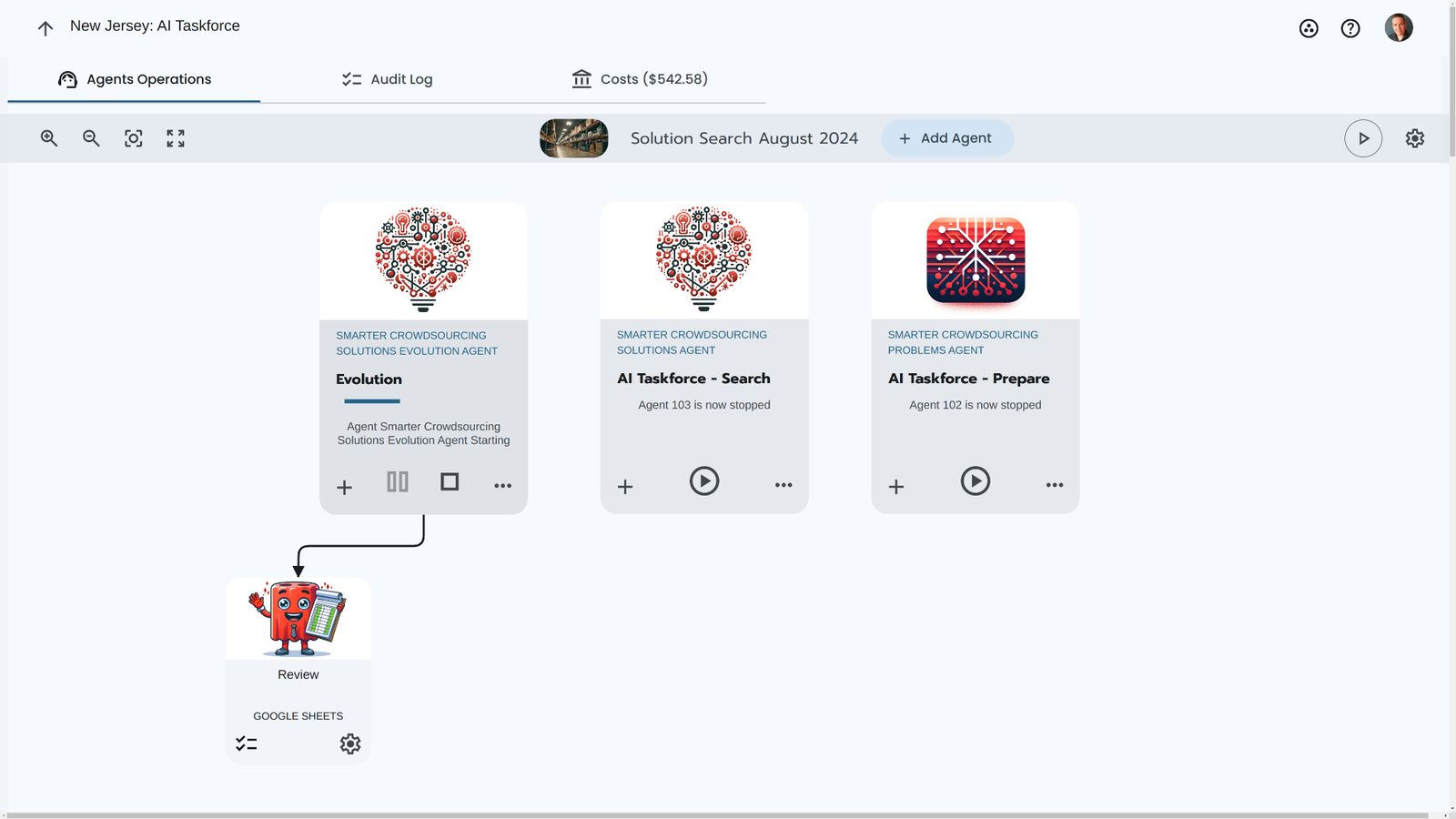
The process had two tracks. On one track, Policy Synth agents conducted large-scale automated research across online sources, academic journals, white papers, and other material to identify workforce risks and policy responses. The system generated 1,451 policy proposals across 20 issue areas.
On the second track, Policy Synth focused on the issues prioritized through worker input. It generated and evolved solutions to the top public-ranked concerns, producing 1,101 policy proposals across 15 issue areas.
This is where the model becomes important. AI did not replace public input. It followed it. Workers helped set the agenda; Policy Synth helped expand the solution space.
Keep People in Control
Policy Synth is built around a human-centered premise. In the 2024 paper Using Artificial Intelligence to Accelerate Collective Intelligence, Róbert Bjarnason, Dane Gambrell, and Joshua Lanthier-Welch describe AI as a way to make collective intelligence more scalable and effective, not as a substitute for human judgment.
New Jersey followed that principle. Subject-matter experts reviewed outputs at each stage. The working group identified eight priority issue areas that appeared across both the AI research and public input tracks, then narrowed roughly 2,500 policy proposals to a shortlist of 40. From there, the Task Force selected recommendations for state leadership.
Reboot Democracy's case write-up describes four recommendations that came out of the process: expand AI-integrated skill development, enhance the NJ Career Navigator with AI-powered labor market monitoring, strengthen transition support for workers, and help small businesses adopt generative AI.
The recommendations were not only theoretical. New Jersey began rolling out free AI skills training for public servants and developing an AI-powered labor market monitoring system to help workers navigate changing career trends. GovTech reported in December 2024 that 10,000 public-sector workers had already been trained or gotten practice using AI tools, and that the state's broader AI work was continuing after the Task Force's report.
The Model
The New Jersey model is useful because it is concrete. It does not ask governments to choose between public participation and technical expertise. It shows how the two can reinforce each other.
Workers identified what mattered. AI agents helped search, compare, generate, and evolve policy options. Experts reviewed the evidence and shaped recommendations. Public leadership then had a clearer basis for action.
That is the role AI should play in democratic decision-making: not deciding for people, and not reducing public input to a symbolic exercise, but helping institutions do the difficult work between listening and acting.
For Citizens Foundation, this is the same principle that runs through Better Reykjavík, Your Priorities, All Our Ideas, and Policy Synth. Better decisions come from structured public input, transparent reasoning, and tools that help people and institutions work through complexity together.
AI can accelerate the work. People still decide.